As part of the LIFE4EPR project, we have gathered valuable insights from our partner Vrije Universiteit Brussel (VUB) to address key questions about the current state and future of Extended Producer Responsibility (EPR) systems in the EU. Their contributions help shed light on the main challenges, opportunities for harmonisation, stakeholder roles, and the project’s impact on raising awareness and improving policy effectiveness.
- What are the main challenges identified in the current EPR systems across the EU?
We consider the following to be among the most persistent and significant challenges facing existing EPR systems in the EU.
- Focus on downstream management and potential conflict with reuse/repair activities: Although predominantly perceived as an end-of-life policy, the concept of EPR takes a life-cycle perspective. By making producers responsible for end-of-life management of their products, EPR seeks to send signals/feedback to producers to make upstream changes (i.e. design and product system improvement). And there exist some evidence on producers making upstream changes for enhancing circular economy (narrowing, slowing and closing loops) and some examples of EPR practitioners working on upper levels of circularity, i.e. slowing loops. However, the prevailing focus of existing EPR programmes has been on downstream, i.e. closing the loop and end-of-life management. Though there have been changes in legislation over time (see Point 2), by and large government officials responsible for implementing and monitoring EPR programmes as well as PROs (producer responsibility organisations) have been putting their efforts on aspects such as improving collection and recycling rates, and on the quality of final disposal (i.e. environmentally sound treatment of what cannot be recycled). However, the potential of inducing upstream changes via implementation of EPR should not be forgotten. A strong focus on downstream activities may make it difficult to enhance reuse/repair, generally a preferable option from environmental perspective.
- Difficulties in implementing individual producer responsibility (IPR) and eco-modulation: The objective to enhance upstream changes via EPR programmes was explicitly introduced as individual producer responsibility (IPR) in the WEEE Directive (2002/96/EC). The introduction of IPR was one of the most contentious items when the 2002 WEEE Directive was discussed and was rigorously pushed by various stakeholders including some producers. However, once the Directive came into force the actual implementation of IPR faced many challenges, such as difficulties in finding a feasible implementation mechanism in a physically collective EPR systems, and lack of political will in some national governments. With the rise of attention to Circular Economy in the early 2010s and the consequent re-recognition of potential roles of EPR programmes in inducing upstream changes and slowing loops, the EU introduced eco-modulation for EPR schemes via revision of the Waste Framework Directive (Directive (EU) 2018/851). The implementation of this requirement faces challenges, however, with an absence of extensive of analysis of likely environmental outcomes and limited examples available so far.
- Lack of clarity regarding fate of collected waste products and recycled materials, and issues of invisible flow and leakage: the strong focus on downstream management (see Point 1 above) contributed to an infrastructure for source separation of waste products covered under EPR programmes, a prerequisite for closing loops. However, the fate of collected waste products and recycled materials requires further policy enforcement and development. There have been continuous incidents of “leakage”, where products that have been collected as “waste” in the EU are sent to non-EU countries, such as some African nations, as “second-hand” products. As these products are not functioning, this is simply waste dumping, which is a violation of the Basel Convention on the Control of Transboundary Movement of Hazardous Waste and its Disposal and causes various negative impacts on human and the environment in the importing countries. In addition, despite improvements in recycling rates achieved in EPR programmes for various waste streams over time, there have not been requirements regarding the quality of recycled materials. This has resulted in much of the recycled materials being downcycled and in uncertainties in actually closing the loops.
- Incomplete data, and limited monitoring and enforcement: While EU Member States have national EPR laws in place at least for waste streams for which EPR legislation has been introduced at the EU level, many countries face issues regarding incomplete data, monitoring and enforcing such laws. For instance, the challenge of leakage mentioned above 3 should have been prevented through proper monitoring and enforcement. Another example is lack of consequences when not meeting collection and recycling targets. Even when producers do not meet recycling targets many years in a row, it is not uncommon that no penalty is imposed on them. Lack of enforcement also has led to the problem of free riders, which economically disadvantages actors who are carrying out their duties properly. This in turn might discourage the diligent actors from continuing to fulfil their duties in the future.
- How can the harmonization of EPR systems across EU member states benefit both the environment and the economy?
One of the main benefits of harmonization would be a reduced transaction and information cost for producers. For instance, as it now stands, the register of producers and information related to their products (e.g. type and quantity of products put on the products) have not been standardised among the EU Member States, which forces producers to tailor their information to the requirements of the respective Member States. The standardisation of this procedure across the Member States would reduce the administrative (and related economic) burden of the producers. Another area where harmonisation would enhance both the environment and the economy are quality standards for recycled materials. Lack of such has been regarded as one of the bottle necks for enhancing the use of recycled materials as raw materials for new products; checking the quality of all in-coming recycled materials would be very costly for producers.
However, careful consideration is required as to which part of the EPR programmes should be harmonised. The socio-economic context of EU Member States varies. Collection of end-of-life products is an area where subsidiarity principle has been alluded to, not only in discussions between the EU and its Member States but also within the respective EU Member States. A collection system that works well in one setting might not work well in another due to differences such as population density, existing collection systems and actors responsible for such systems and the like. This example highlights that EPR programmes contain a number of aspects that may not have a “one-size-fit-all” solution suitable for all EU Member States.
- What role will stakeholders, including producers, recyclers, consumers, and policymakers, play in the success of the LIFE4EPR project?
The LIFE4EPR project has the overall objective to “support policy making through giving a clearer picture on the state of play of the EPR schemes set up across the EU, aiming at enhancing the effectiveness, governance, enforcement and waste management of concerned products.” In order to achieve this objective, we need to collect information from various ends and reflect upon voices of all the stakeholders as much as possible. We would be grateful if all the stakeholders could collaborate with us by providing us with information, directing us to sources of information, as well as, sharing their view regarding the strengths and points of improvement in the current systems, and their vision of the future. The type of concrete information, views and inputs we are looking for from different stakeholders are exemplified below.
- Producers: We would be keen to learn whether, how and how much the existing EPR programmes, especially in relation to implementing IPR and eco-modulation, might impact their design strategies. This contributes to understanding the effectiveness of EPR programmes in inducing upstream changes. Moreover, in addressing the current inefficiency of EPR programmes in the EU, we seek to develop a pilot register harmonised across the EU and test it. In developing and experimenting with its use, we would like to learn about the experiences of producers in existing MS registers. We would also like the producers to be engaged in testing the pilot register.
- Producer Responsibility organisations (PROs): an essential component of the LIFE4EPR project is to map all the EPR systems in the EU, followed by a benchmarking study. Here, the collaboration by PROs in supplying information about themselves that is difficult to obtain from publicly available sources is critical. We would also be grateful if the PROs could help us in reaching their members (i.e. producers).
- Municipalities and retailers: These are often the actors responsible for collecting end-of-life products from consumers, a critical point in closing the material loop, and a potential facilitator in slowing it. Thus, it is essential to learn their experience on what has/has not worked regarding collection and further distribution to subsequent end-of-life actors, as an interface between refurbishers/repairers/second-hand market actors/recyclers and consumers.
- Recyclers: It would be invaluable to obtain recyclers’ views and selected information to understand the effectiveness of the downstream operations in EPR programmes, especially regarding the closing of material loops (e.g. means of collecting data for input and output, quality of incoming and outgoing materials, technological challenges, collaboration with other actors in value chain such as raw material suppliers, producers). Equally important, though somewhat delicate, are their views on reuse/repair/refurbishment (slowing loops) via EPR programmes.
- Refurbishers/repairers: Though relatively new to the EPR system, the prominence of refurbishers and repairers has been increasing in light of furthering a more circular economy (slowing loops). Their inputs as to what promotes/enables/hinders their activities in the current EPR systems, as well as existing activities that work well, could significantly contribute to improving the current systems.
- Consumers: For the majority of products under existing EPR programmes it is the consumers who decide the fate of the products after their purchase. The LIFE4EPR project benefits a lot from learning about consumers’ view related to slowing loops (e.g. what makes it easy or difficult to repair their products) as well as closing loops (e.g. what makes it easy or difficult to bring their waste to the right place). Given the practical difficulties of obtaining the views of individual consumers, however, we would most likely need to find and assess existing research on such.
- Policy makers at the Member States level: in EPR system mapping exercise, MSs can be very helpful in verifying the data the LIFE4EPR members gather. Their view and experiences on the design and implementation of current EPR systems is also critical for the subsequent in-depth analysis of selected systems. Finally, Member States can share their views on the developed pilot register.
- Policy makers at the EU: the involved EU civil servants can advise as to what inputs would be of most use for their policy making. This would benefit the LIFE4EPR project a lot, allowing to set the right focus for and streamlining the research.
- How will LIFE4EPR contribute to raising awareness about EPR systems among EU institutions, member states, and the public?
We aim that the knowledge created through the LIFE4EPR project itself would:
- Facilitate the EU institutions in making informed decisions regarding their current and future policy making;
- Provide a source of reflections for the Member States as to their current implementation of EPR programmes; and
- Guide and provide inspiration for all the involved stakeholders in optimising the functioning of the EPR systems they are a part of
- Provide the public with enhanced knowledge about the EPR programmes per se as well as their roles in the programme, via various communication campaigns planned towards the end of the project.
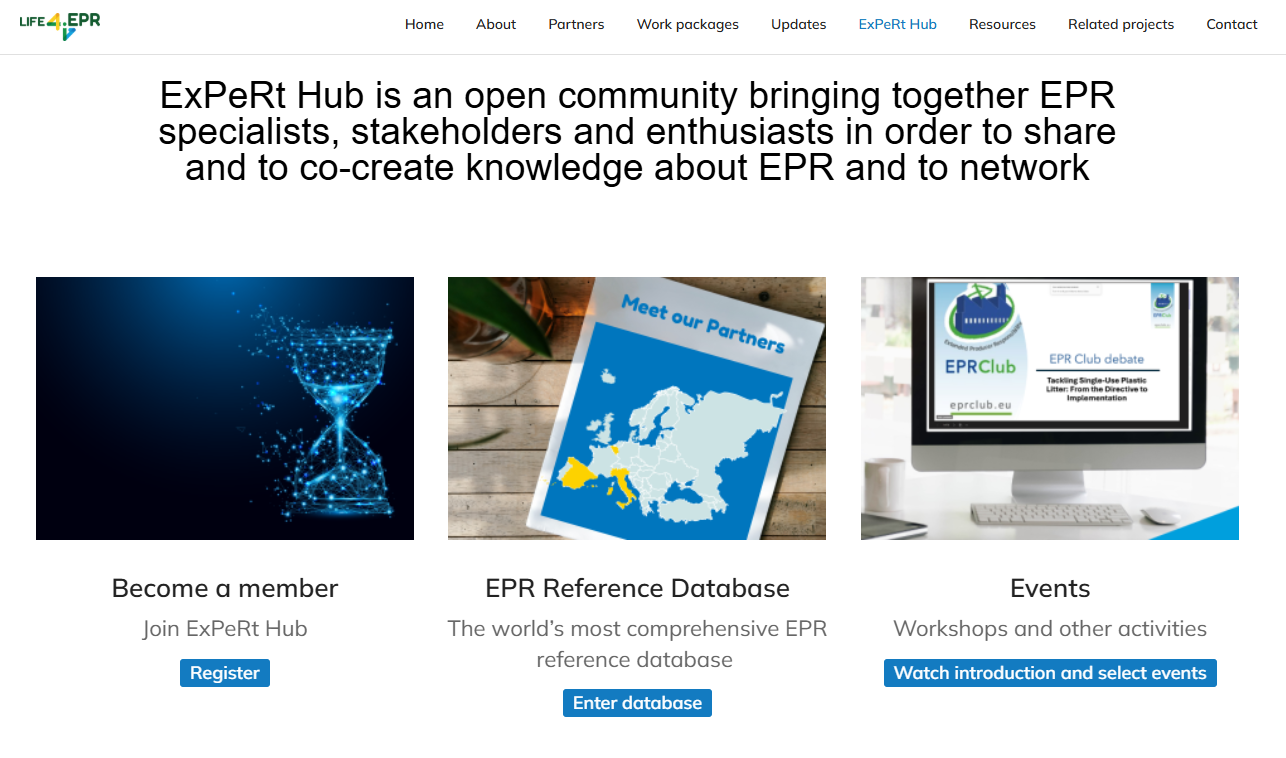
As a way of enhancing exchange of knowledge among various stakeholders, the LIFE4EPR project will create and facilitate “ExPeRt”, an EU-wide community of experts on EPR. In addition to promoting the communication among stakeholders both within specific waste streams (e.g. electronics, packaging…), as well as among actors across waste streams (e.g. producers, recyclers…), the project seeks to utilise the knowledge community for facilitating data collection and discussing the project outcomes. EU institutions and Member States representatives working with EPR are invited to join ExPeRt. We also hope to engage organisations working with consumers to obtain the voices of the public in ExPeRt community.